The Real Pioneer Plaque
The Pioneer 10 spacecraft, launched in 1972 ("Gosh, 1972! Were there people then?"), was the first man-made object to leave the solar system, to become our very first interstellar spacecraft. Designed to last for 21 months, it functioned for more than 30 years, returning our first direct observations of Jupiter and paving the way for later missions such as Voyager, Ulysses, Galileo, and Cassini. It will continue heading into interstellar space in the direction of the star Aldebaron until it is destroyed by a Klingon warship in Star Trek V: The Final Frontier.
The Original Pioneer Plaque
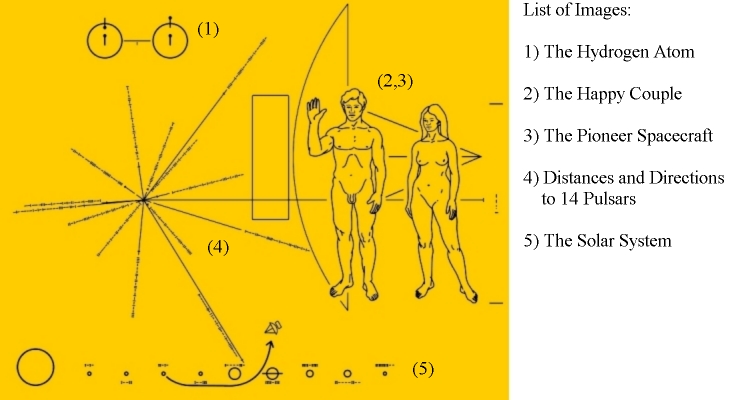
As Pioneer 10 was being prepared for launch, scientists and managers associated with the mission decided it would be appropriate to attach a message to the spacecraft in the event that it was recovered, sometime in the distant future, by some race of space-faring aliens. This took the form of the famous Pioneer Plaque. Designed by the late Carl Sagan and his wife, Linda Salzman Sagan, the Pioneer Plaque became one of the cultural icons of the late 20th Century, and numerous articles about it can be found on the Internet. In its original form, shown above, it contained several images designed to convey information to beings that would have no knowledge of our language, writing systems, or culture.
 1) The Hydrogen Atom. These two circles can represent several
things: 1) Groucho Marks's eyeglasses, 2) a universally recognizable
depiction of the electron spin transition of hydrogen (the famous '21
centimeter line') which can serve as a unit of time and distance, or 3)
the emblems of
Doctor Manhattan
and his
brother Biff,
included to warn the aliens that Earth is defended by
powerful superheros who will defeat any attempt to harvest us as food
animals.
1) The Hydrogen Atom. These two circles can represent several
things: 1) Groucho Marks's eyeglasses, 2) a universally recognizable
depiction of the electron spin transition of hydrogen (the famous '21
centimeter line') which can serve as a unit of time and distance, or 3)
the emblems of
Doctor Manhattan
and his
brother Biff,
included to warn the aliens that Earth is defended by
powerful superheros who will defeat any attempt to harvest us as food
animals.
 2) The Happy Couple. Line drawings of a man and woman were included
so the hypothetical aliens would know what we looked like. There was some
debate as to whether the figures should be clothed, so as not to annoy
fundamentalists and the like, but it was decided to leave them nude, which
is fortunate, for any aliens who got a good look at the fashions of the 70's
would almost certainly launch warships to destroy us. It was suggested that
the figures should be holding hands, but Carl Sagan was concerned the aliens
might think they represented a single organism. Right. Sure thing. When
the images became public, some women's groups objected that the figure on
the left -- easily recognizable as female by its scrotal egg sac and
dangling ovipositor -- was portrayed raising her hand in a gesture of
submission while the male figure on the right -- distiguished by its smaller
size, muscular legs, and the two prominant external testes protruding from
its chest -- had its arms lowered in the universal gesture of dominance.
For this reason, a
similar message
on the Voyager spacecraft portrays both figures with their hands raised.
2) The Happy Couple. Line drawings of a man and woman were included
so the hypothetical aliens would know what we looked like. There was some
debate as to whether the figures should be clothed, so as not to annoy
fundamentalists and the like, but it was decided to leave them nude, which
is fortunate, for any aliens who got a good look at the fashions of the 70's
would almost certainly launch warships to destroy us. It was suggested that
the figures should be holding hands, but Carl Sagan was concerned the aliens
might think they represented a single organism. Right. Sure thing. When
the images became public, some women's groups objected that the figure on
the left -- easily recognizable as female by its scrotal egg sac and
dangling ovipositor -- was portrayed raising her hand in a gesture of
submission while the male figure on the right -- distiguished by its smaller
size, muscular legs, and the two prominant external testes protruding from
its chest -- had its arms lowered in the universal gesture of dominance.
For this reason, a
similar message
on the Voyager spacecraft portrays both figures with their hands raised.
 3) The Pioneer Spacecraft. The sketch behind the two human figures is
a schematic representation of the Pioneer spacecraft, included to provide a
sense of scale. At least that's what it's supposed to be. No one I've
asked has ever noticed this sketch until it was pointed out to them, so it's
safe to assume the aliens won't notice it either.
3) The Pioneer Spacecraft. The sketch behind the two human figures is
a schematic representation of the Pioneer spacecraft, included to provide a
sense of scale. At least that's what it's supposed to be. No one I've
asked has ever noticed this sketch until it was pointed out to them, so it's
safe to assume the aliens won't notice it either.
 4) Distance and Directions to 14 Pulsars. At least there are
supposed to be 14 -- you try counting. Their spin periods are indicated by
binary strings based on the transition time of the electron spin transition
of the hydrogen atom (see above). This image was intended to show the
aliens where our planet is located, so they'll know where to send their
invasion fleets. Unless they read the strings backwards, in which case
they'll become hopelessly confused and invade some entirely different
world by mistake.
4) Distance and Directions to 14 Pulsars. At least there are
supposed to be 14 -- you try counting. Their spin periods are indicated by
binary strings based on the transition time of the electron spin transition
of the hydrogen atom (see above). This image was intended to show the
aliens where our planet is located, so they'll know where to send their
invasion fleets. Unless they read the strings backwards, in which case
they'll become hopelessly confused and invade some entirely different
world by mistake.
 5) The Solar System. The sketch at the bottom of the plague shows a
schematic representation of our solar system along with binary strings to
show the orbital periods of the planets to any aliens who read from left
to right -- aliens who read from right to left are out of luck. It also
shows the trajectory of the Pioneer 10 spacecraft, which left Earth and
swung by Jupiter on its way to interstellar space. I have no idea if a
different plaque was placed on Pioneer 11, which swung by Saturn instead.
Note that this sketch reflected the knowledge at the time Pioneer was
launched, so it didn't show rings around Jupiter, Uranus, and Neptune.
It also portrayed Pluto as a planet. Presumably the IAU will launch a
mission as soon as we have faster-than-light travel to find Pioneer 10
and erase this part of the image.
5) The Solar System. The sketch at the bottom of the plague shows a
schematic representation of our solar system along with binary strings to
show the orbital periods of the planets to any aliens who read from left
to right -- aliens who read from right to left are out of luck. It also
shows the trajectory of the Pioneer 10 spacecraft, which left Earth and
swung by Jupiter on its way to interstellar space. I have no idea if a
different plaque was placed on Pioneer 11, which swung by Saturn instead.
Note that this sketch reflected the knowledge at the time Pioneer was
launched, so it didn't show rings around Jupiter, Uranus, and Neptune.
It also portrayed Pluto as a planet. Presumably the IAU will launch a
mission as soon as we have faster-than-light travel to find Pioneer 10
and erase this part of the image.
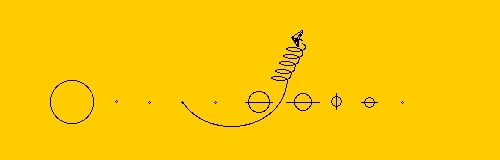
The Real Pioneer Plaque
After the original plaque was mounted on Pioneer 10, authorities became concerned that it did not provide an adequate representation of our society, art, science, and culture. In particular, it didn't show any examples of a hang glider climbing out in a thermal, which surely must represent the pinacle of human achievement. For this reason, in the final days before launch, the image at the bottom of the Pioneer plaque was modified as shown below.